Saturday, June 1, 2013

The Haunted Restaurant


Los Angeles is a haunted city.  Beneath the metropolis the earth’s crust is stratified with history—the pueblo years, old movie sets, blood and assassinations, murders, riots, bottles, glass and buildings—a hodgepodge of broken promises and missed opportunities.

And of course, there are ghosts.

We tear down almost as soon as we have finished building.  The past is a mirage in L.A., but even though the physical evidence has been bulldozed, the detritus swept away, the ghosts linger.  If you listen, you will hear them wailing down the canyons during a bout of Santa Ana winds.

Those canyons are mythical in Los Angeles:  Laurel Canyon, Coldwater Canyon, Benedict Canyon, Beverly Glen, the Sepulveda Pass, Topanga Canyon.  This is because in the unique topography of L.A., the Santa Monica Mountains and the Hollywood Hills separate downtown and the city proper from the San Fernando Valley.  To drive from the north end of L.A. to the south requires passage over a freeway or through a winding canyon road along asphalt streets that cover old wagon trails.  The history gives these canyons the creepy feelings.  Charles Manson and his “family” murdered in these canyons.  Eddie Nash and his gang committed the Wonderland Murders up in Laurel Canyon.  Bodies are buried in partially-dug graves.  Mountain lions and coyotes roam the hills snatching up smaller game like Pekinese puppies and house cats.  There are ghosts and there is a darkness.

For years, I traveled over Beverly Glen to get to work, and every day I would pass by the Four Oaks Restaurant, a charming little place deep in the canyons.  Often, when it was lit up on a warm spring night, I would make a mental note to go there someday and have dinner.  But I never did.  My wife and I wanted to throw a party to celebrate our 20 year wedding anniversary at Four Oaks, but when we went to the place one day, we found the door locked and the restaurant shuttered.  It has remained closed for the last eight years, according to what I could find about the site in the Los Angeles Times.  Evidently, the last meal came out of the kitchen in 2005.


Doing some research about the history of the area, I stumbled upon two accounts of Four Oaks’ unique and haunted past.  The site of the restaurant was a stopping point for travelers moving over the hills to Los Angeles proper.  The drive that now takes 30 minutes depending on traffic was once a grueling trip requiring most of the day.  Legend has it that the Four Oaks name came as a result of a massive tree nearby formed from the trunks of four separate trees.  As time and civilization progressed, roads were paved and the journey became less arduous, and that is when the trouble started.  The restaurant became a speakeasy in the 1920s with illegal hooch and prostitutes.  Given the clientele, a number of bad things could have happened on that piece of real estate.  The one documented case was a doozy.  Down a bit from the current Four Oaks site, a man stormed into a roadhouse and confronted his wife in bed with her lover.  In a rage, he hacked off the male adulterer’s head with a scythe, bathing the room in blood.  The locals captured the murderer and hanged him, and the wandering wife inherited all of the man’s money and property.  According to legend, the husband and his victim still wander the area at night, one of them dressed “in his favorite yellow opera cape,” says Jeff Dwyer in his book, Ghost Hunter’s Guide to Los Angeles (Pelican, 2007).  A second apparition has been seen inside the Four Oaks Restaurant and is described by Dwyer as “a large, glowing apparition that hovers near the fireplace in the dining room or in the bar.  It has been seen by many but no one can give a clear description of the ghost’s features or determine if it is a man or woman.”

In a second book, Haunted Places:  The National Directory (Penguin, 2002) by Dennis William Hauck, the figure in yellow relates to the woman involved in the crime.  She supposedly loved the color yellow, so her headless, yellow-clad lover haunts the road looking for her, and probably his head, too.


I did not see any yellow headless ghosts when I went to the site recently.  It was just another abandoned restaurant or place of business like so many others around the city after the recession.  However, the canyons of L.A. often give me a shiver.  The houses are old, the trees whisper in the wind, and especially at night, strange figures often walk the streets.  But on my trip to Four Oaks on a recent warm day, I walked around the property unmolested.  The only interesting thing were the pictures I took.  I kept getting the double-exposure like reflections in the glass as I snapped shots through the windows.  Normally, I would edit them out or try a different angle, but in this case, I kind of liked them.  History is a layered effect, and I liked the ghost images reflected back in the glass and superimposed on the shot.


The Four Oaks Restaurant is located at 2181 North Beverly Glen Boulevard in Bel Air.  The old roadhouse is in the 1400 block of North Beverly Glen.  According to Jeff Dwyer, it is no longer occupied.


Monday, May 27, 2013

War Photography at the Annenberg


The Annenberg Space For Photography is ending its exhibit entitled War/Photography: Images of Armed Conflict and Its Aftermath this week (closes June 2).  On display are over 170 photos from the 19th century through current conflicts in Iraq and Afghanistan.  The prints include images of battle, daily life, the consequences of war, impact on soldiers as well as civilians, and what happens when the fighting ends. It is a moving and elegiac documentation of human conflict and its destruction.

The best part of the exhibit is the documentary displayed on two large screens at the center of the space.  In the film, photographers discuss their experiences and the resulting work.  One of the photographers featured is Pulitzer Prize winner Carolyn Cole, who works for the Los Angeles Times.  Over the years, she has photographed everything from the North Hollywood bank shootout to Liberia and other war torn areas of the world.  Her work is stunning in its richness and vibrancy.  She is one of many journalists featured in the documentary who continue to provide the world with up-close images and stories.

The Annenberg Space For Photography is located at 2000 Avenue of the Stars, Los Angeles (actually in the area known as Century City, a few miles west of downtown).  There is a Thursday night lecture series, called Iris Nights, that begins at 6:30 PM.  Admission to the space is free, and discounted parking with validation is available under the building.  The entrance is on the north side off of Constellation Boulevard.  Hours are Wednesday through Sunday, 11 AM to 6 PM.  Saturday, the space stays open to 7:30 PM.  The exhibit is closed Monday and Tuesday.

This exhibit is a great way to observe Memorial Day here in Los Angeles.


Wednesday, May 15, 2013

The Bees of Summer


It is, by every measure, summer in Los Angeles.  Over the last weekend, we had triple digit temperatures.  More and more we are reduced in the metropolis to two seasons:  summer and a slightly cooler version of summer.  Cold weather, at least the kind found in California, really only seemed to visit for a week in December.  Rain?  A few drops does not end the drought.  Fire season has begun, and if the prognosticators are to be believed, this year will mature into red dawns and ashy skies.  The coming inferno could be cataclysmic and incredibly destructive by late-summer-into-fall.

For all those still trying to deny global warming, good luck with that.

The beaches are already beginning to fill up, corn-on-the-cob and early stone fruits are coming to market.  The grills and barbecues stand at the ready.

I stole a few moments last week to walk the hills above Santa Monica to snap some photos of the hardest working crews plying their trade in the shadows and light:  the bees.

Yes, summer’s here.


Wednesday, May 8, 2013

To The Gibson Amphitheater: Thank You and Goodnight


The place has seen saints and sinners:  the Dalai Lama and Pope John Paul II; George Carlin and Chris Rock.

Heads of state and rock royalty have shouted out from the stage:  Barack Obama and Bill Clinton; B.B. King, Miles Davis, and Joni Mitchell.

I personally witnessed great performances by Weather Report, Elton John, Steve Winwood, James Taylor, Kenny Loggins, Natalie Cole, Toto, Michael McDonald, and Dan Fogelberg.

My memories include nearly getting arrested when I snuck backstage to meet Chuck Mangione.  Then there was the New Year’s Eve debacle with Barry Manilow where the guy behind me in the balcony threw up into his party hat for a good 30 minutes before medics could extract him from his seat.

My first date with my wife was to see Christopher Cross perform at the Universal Amphitheater (as it was called until 2005 when the Gibson Guitar Company bought the naming rights).  The girl I originally asked turned me down.  My wife never lets me forget that she was second choice.

On the subject of love, we were well into our married years when someone gave us front row seats at the Tom Jones concert.  During “What’s New, Pussycat?” a mob of middle-aged women rushed the stage and a barrage of panties flew over our heads like so many brightly colored cotton birds.  I thought I’d seen it all when several women lifted their shirts to shake their bare breasts at the gravelly-voiced Tom.  I was traumatized.  Tom took it all in stride and turned in a stellar performance, ever the consummate professional.

The venue started life as an open air amphitheater in a Hollywood back lot with a few exhibits and a studio tour.  The first performers were the cast of the rock musical Jesus Christ Superstar.  I saw one of the last concerts there in the early 1980s before it closed for remodeling.  The grand reopening in 1982 featured an enclosed space with state-of-the-art sound and lighting.  These were the days when the Universal Amphitheater was the concert venue in Los Angeles.  The Fabulous Forum was larger, but Universal did not have a bad seat in the house.  It was intimate yet held more than 6,000 people.

Backstage, the name of every performer who graced the 41 year-old hall has been stenciled on the walls.  Lots of history; lots of great performances.


This fall, the place will be demolished for “The Wizarding World of Harry Potter.”  It seems Universal Studios is coming late to that party; Harry Potter is old now.  It is an unfair trade.  The amphitheater had more than a few good years ahead of her with a little remodeling and a technology upgrade.  The competition from the Staples Center, Nokia Theater, the Greek Theater, and the Hollywood Bowl as well as smaller venues like the Walt Disney Concert Hall have all drawn artists and audiences away from the Gibson.

Recently, I attended an event there and was able to wander around a bit both in the front of the house and backstage where these photographs were taken.  There was the occasional loose railing or wobbly seat, but she looked good for four decades of use.

We tear down things too quickly in this city.  In the process, we erase cultural icons and discard our history.  But there is beauty in the aged and lined faces of buildings.  Who needs a “Wizarding World?”  We can visit that place in the books and films.  Great performances live on in our memories.  A searing guitar solo and another encore never get old.

By the close of 2013, the Universal-Gibson Amphitheater will be dead and gone.  Construction jackhammers and bulldozers will silence the thundering applause.  The history, the performers, the music will remain only with those of us who remember.  And that will have to be enough.


Thursday, May 2, 2013

Urban Farming With The Tapia Brothers


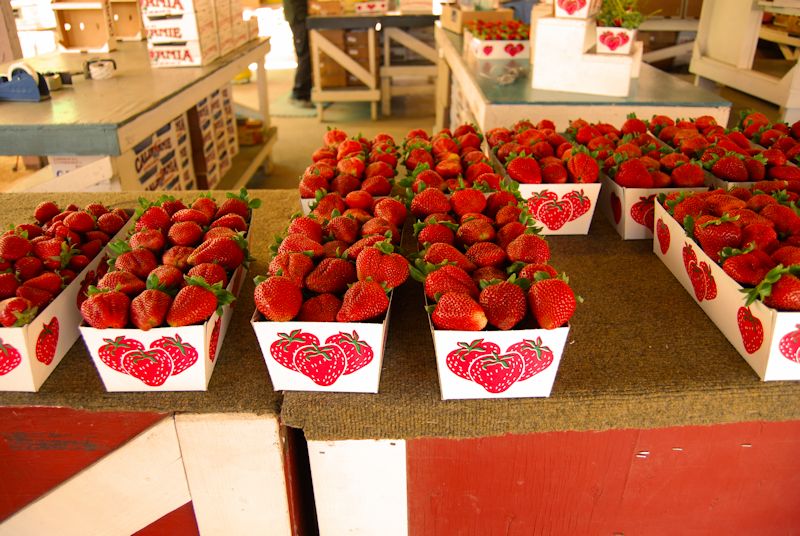
The Tapia Brothers farm and produce stand in Encino is a fruit-and-vegetable lover’s dream.  In the middle of the Sepulveda Flood Control Basin, brothers Tom and Felix Tapia grow all kinds of produce.  Specifically, they are known for sweet corn-on-the-cob and strawberries, both of which are in season now.

The farm sits on 100 acres at the intersection of Burbank Boulevard and Hayvenhurst Avenue alongside the 101 freeway.  The brothers have farmed the acreage since 1984.  Before that, they had a stand near Santa Clarita in Bouquet Canyon.  My father used to stop there for corn and strawberries after a day of hunting in the mountains.  I went to high school with Eddie Tapia, a member of the multi-generational farming family.

I make it a habit, especially this time of year, to stop by the stand on Saturday or Sunday to pick up strawberries, grape tomatoes, oranges and zucchini for the week.  Usually I wind up sharing with neighbors because the price is good and everything is so fresh.  During the month of October, the entire stand is turned into a pumpkin patch complete with scarecrow zombies and other scary creatures.  The colder months bring fresh Christmas trees.  All year round there are goats, sheep, chickens and a rabbit or two who are friendly and eager to greet visitors.

The stand is open Monday through Saturday, 9AM-6PM and Sunday, 9AM-5PM.  My weekend trip to the farm in the middle of the city has become a way of supporting something that is rooted in my past.  Every month, more of the places I remember from childhood disappear, victims of the developer’s bulldozer, or simply the casualties of a poor economy.  Thankfully, Tapia Brothers is still around.  It is rare to find such a place in a big city like Los Angeles.  Prices are reasonable and the produce can’t be topped.  Here are some pictures from a recent trip: